
This week in our poetry news round up we look at the poetry taking place at the Edinburgh International Book Festival and the tenth anniversary line up for the BBC’s Contains Strong Language festival.
Poetry Takes Centre Stage at the Edinburgh Book Festival
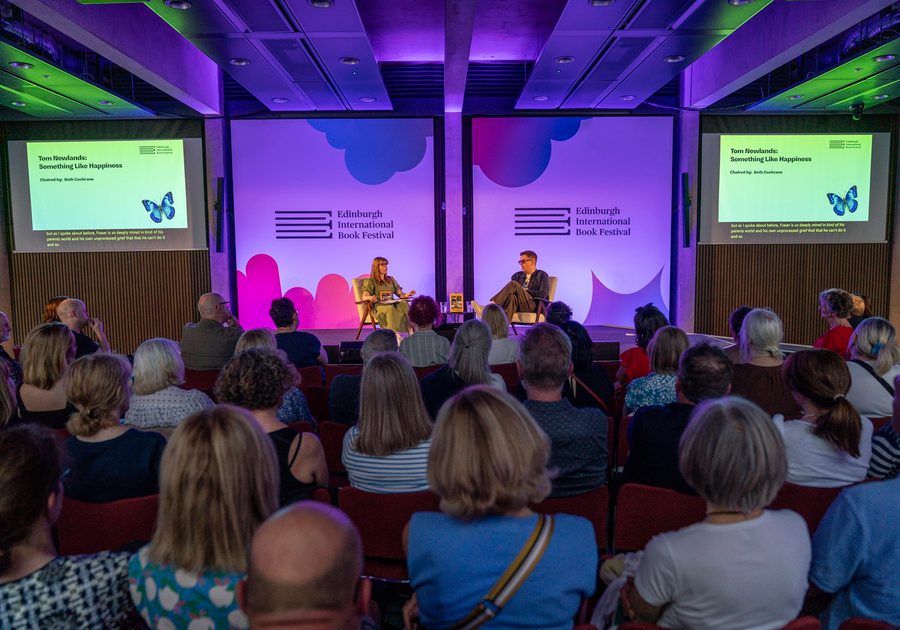
The Edinburgh International Book Festival is currently in full swing at the Edinburgh Futures Institute, where it runs until 30th August. This year’s programme, built around the theme “Changing Your Mind”, takes in close to 600 events and writers from 41 different countries, and poetry has had a prominent place in it all week.
The Scots Makar Peter Mackay got things underway on the 16th with Our Many-Voiced Country, an event showcasing poets working in Scotland in languages ranging from Catalan to Arabic, and which included a reading in Tamil by the new MSP Q Manivannan. The following day Mackay was joined by the UK Poet Laureate Simon Armitage and the Welsh National Poet Hanan Issa for Poetry of the People, a discussion of whether poetry can be said to have a national identity at all – a question with a particular charge in a country that long ago made a national institution of Robert Burns. The same day saw A Verse of Poets bring together Clementine E Burnley, Ceitidh Chaimbeul, Taylor Dyson, Hannah Lavery, Michael Mullen and Andrés N Ordorica.
Armitage returned on the 18th to read from New Cemetery, the collection prompted by the conversion of a beauty spot near his moorland home in West Yorkshire into a municipal graveyard, and which reviewers have read as a conversation with the landscape and with forebears such as Ted Hughes. Kae Tempest appeared the same evening, in conversation with Michael Pedersen about a debut novel that took a decade to finish.
Translation has been the other thread running through the week. On Thursday the Korean poet Lee Seong-bok and his translator Anton Hur discussed That Summer’s End, recently published in English, with the poet Andrew McMillan. The conversation examined love, loss, pain and beauty in Lee’s work and the choices involved in carrying its highly compressed language across into English. Hur described trying to hold on to the rhythm, ambiguity and imagery of the originals while allowing the poems to stand up on their own for English readers. It was the second year running that the festival has partnered with the Korean Cultural Centre UK. Hur had appeared the previous day alongside Polly Barton and Daniel Hahn for In Other Words, a session on what is left to human translators in an age of rapidly improving artificial intelligence.
Contains Strong Language Turns Ten with a Move to Salford
Tickets are now available for the BBC’s Contains Strong Language festival, which marks its tenth anniversary next month with its first ever visit to Salford. The poetry, spoken word and performance festival takes place from the 24th to the 27th of September across Salford and MediaCity, and forms part of the city’s centenary celebrations.
The line up brings together John Cooper Clarke, Jackie Kay, Joelle Taylor, Len Pennie, Jason Allen-Paisant, Liz Berry, Owen Sheers, Alice Oswald, Testament, Andrew McMillan and Toria Garbutt, alongside emerging poets from Manchester, Salford and further afield. Highlights include live recordings of Radio 4’s Front Row, Loose Ends, Start the Week and the poetry programme The Verb, a presentation of Simon Armitage’s adaptation of Gilgamesh, and a collaboration with the BBC Philharmonic Orchestra and Radio 3’s Words and Music. Armitage will also appear in conversation with Cooper Clarke on the 26th.
There is a strong local emphasis too, with BBC Radio Club projects running in schools, work with Salford Youth Zone, animations made by Manchester Metropolitan University students and a programme of workshops. Cooper Clarke, the Bard of Salford, noted that “strong language and the city of Salford are a universally recognised double act”, and wondered aloud whether he was worthy of his meeting with the current Poet Laureate.



You must register to comment. Log in or Register.