
This week in our poetry news round up we look at the winner of the 2026 Booker Prize and two of Canada’s biggest poetry awards, and we pay tribute to the poet and compere Dónall Dempsey.
M. John Harrison Wins the 2026 Booker Prize
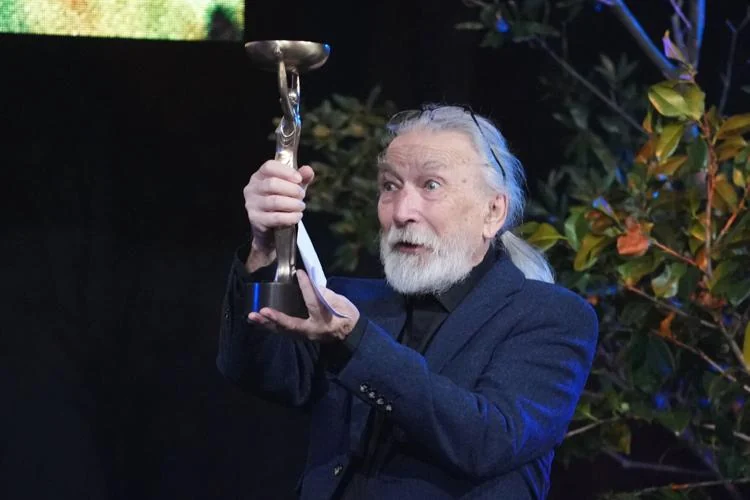
The British writer M. John Harrison has been named the winner of the 2026 Booker Prize for his novel The End of Everything. At 81, Harrison becomes the oldest winner in the prize’s history, overtaking Margaret Atwood, who was 79 when she shared the award in 2019.
The End of Everything is a satirical, post-apocalyptic novel about a man who combs the Kent shoreline for the strange objects that wash up out of the Channel. It is Harrison’s 13th novel and his first ever Booker nomination. He has spent most of his long career writing science fiction, and his 2006 novel Nova Swing won both the Arthur C. Clarke Award and the Philip K. Dick Award. Gaby Wood, chief executive of the Booker Prize Foundation, said that while many past winners had borrowed elements of science fiction, Harrison was the first to come from the science fiction world itself.
The judges, chaired by the classicist Mary Beard, spent a whole day debating the six shortlisted novels before reaching a unanimous decision. Beard described the winning book as “the politics of now seen through the lens of the future”.
There was plenty in this year’s prize for poetry lovers too. The judging panel included the poets Raymond Antrobus and Patricia Lockwood, alongside Pulp frontman Jarvis Cocker and the critic Rebecca Liu. Two of the shortlisted novelists are also acclaimed poets. Luke Kennard, whose collection Notes on the Sonnets – an irreverent response to Shakespeare’s sonnets – won the Forward Prize for Best Collection in 2021, was shortlisted for Black Bag. Rebecca Perry, whose collection Beauty/Beauty was shortlisted for the T.S. Eliot Prize, made the list with her debut novel, May We Feed the King.
Harrison received £50,000 and a trophy, presented to him by last year’s winner David Szalay, at a ceremony at Old Billingsgate in London on Monday 9th November. The evening was broadcast live on BBC Radio 4’s Front Row.
Canada Honours Poets Gillian Sze and Margaret Christakos
It has been a big week for poetry in Canada, with two of the country’s major poetry awards handed out within days of each other.
On Thursday, the Canada Council for the Arts announced the winners of the 2026 Governor General’s Literary Awards, with the Montreal poet Gillian Sze taking the English-language poetry prize for An Orange, A Syllable. The collection is a sequence of prose poems charting a period of motherhood and artistic change, as its speaker witnesses her young child’s first words and reflects on how language begins in us and where it reaches its limits. The book had already won this year’s A.M. Klein Prize for Poetry.
Born and raised in Winnipeg, Sze teaches creative writing and literature at Concordia University and previously won the Pat Lowther Memorial Award for her book of poems and essays, Quiet Night Think. The French-language poetry award went to Vincent Lambert for Le royaume des chuchotements. The 14 winners across all categories were chosen from more than 1,200 books, and each receives C$25,000.
Earlier in the week, at the Writers’ Trust Awards in Toronto on Tuesday 10th November, Margaret Christakos was named the winner of the C$60,000 Latner Griffin Writers’ Trust Poetry Prize. The award honours a mid-career poet for a remarkable body of work, as well as in anticipation of what is still to come. It is supported by the Albert and Temmy Latner Family Foundation and Scott Griffin, the benefactor behind the Griffin Poetry Prize.
Originally from Sudbury, Ontario, and now based in Toronto, Christakos has published 12 books of poetry, including Excessive Love Prostheses, which won the ReLit Award, and most recently That Audible Slippage. In their citation, the jury praised the way her poems about the Earth, and our modest place within it, choose humility over despair.
Tributes Paid to Poet and Compere Dónall Dempsey
The Irish poet Dónall Dempsey, a much-loved figure on Surrey’s open-mic scene, has died from cancer at the age of 70. After the news broke, fellow poets took to social media to remember his energy, warmth and generosity, with the performance poet Luke Wright saying: “I was so glad to know him, he was magical.”
Born in 1956 in the Curragh of Kildare, Dempsey was proud of being Ireland’s first poet in residence at a secondary school. Being dyslexic, he learned by listening, and his love of poetry started early: he first heard W.B. Yeats recited on his sister’s knee during a thunderstorm, while his father would come in from the garden quoting Thomas Hood.
He moved to London in the 1980s, where he completed a university degree and became a familiar face on the city’s poetry scene. His poems drew on his years as a care worker, his time as a London schoolteacher and his life as a father, as well as on his childhood in Ireland.
After meeting his wife Janice, an artist and poet, at a poetry workshop, the couple settled in Guildford, where they ran a string of popular open-mic nights, The 1,000 Monkeys, at venues including Bar Des Arts, The Keystone and The Keep. After the pandemic, the nights moved online as a monthly event. Through their press, Dempsey & Windle, the couple first published annual anthologies before moving on to pamphlets and full collections in 2016, and more than 100 poets have now been published by them.
Dempsey’s own collections include Gerry Sweeney’s Mammy, Crawling Out and Falling Up and The Fox, The Whale and The Wardrobe. Following surgery in 2025, he kept writing and sharing poems online, many of them humorous pieces that made light of his illness. His final poem was a love poem to Janice.



You must register to comment. Log in or Register.